Wednesday, March 30, 2016
Selena Gomez teases new music video as Instagram extends duration limit to 60 seconds

Selena Gomez teases new music video as Instagram extends duration limit to 60 seconds
Tuesday, March 29, 2016
30-year Treasury yield down 1.7 basis point to 2.640%


30-year Treasury yield down 1.7 basis point to 2.640%
Monday, March 28, 2016
5 Neuroscience Secrets to a Better Customer Acquisition Engine
Your brain contains approximately 100 billion neurons, which are the cells that enable you to process information. What makes these neurons exponentially more powerful is the electrical or chemical connections they create with one another through synapses – your brain actually houses approximately 2 ½ miles of neuronal network interconnections in every cubic millimeter of gray matter.
Clearly, your brain packs quite the punch. In fact, last year a PhD student from Carnegie Mellon University collaborated with one from University of California, Berkeley to calculate that the human brain is actually up to 30X more powerful than the world’s most powerful supercomputer. Incredible, right?
When considering the dominating influence that the human brain has on the purchase decisions being made by a company’s target audience, it’s stunning how little focus is applied to neuroscience in the customer acquisition development process at many companies.
It behooves any marketer to leverage the power of neuroscience in attracting attention, building relationships, and moving prospects to action. To that end, here are five effective ways to use neuroscience to rev up your customer acquisition engine.
1. Deviate
First, you need to grab the attention of your target audience. On average, your prospective customer encounters over 5,000 marketing messages daily, and this doesn’t even count social media. What’s a marketer to do to cut through all the noise?
Deviate! The brain is hardwired to love surprises, as evidenced in neuroscientific studies lead by Gregory S. Berns, M.D., Ph.D at Emory’s Neuroimaging Group. Using magnetic resonance imaging (MRI) to measure brain activity, Berns’ team showed that the brain actively responds more to the unexpected than even to things a person likes or finds pleasurable.
The dashboard SaaS company, Domo, which targets business executives, ran a series of ads screaming “CFO Porn!” and “Stop making I.T. your report monkey” in an otherwise serious market where they could have otherwise released standard ads about big data.


When seeing the ads, you couldn’t help but click on them. With Domo’s annual revenue reportedly approaching upwards of $100 million, deviation has certainly helped it to stand out.
The monthly razor subscription company Dollar Shave Club has utterly upended a mature industry with its series of jaw-dropping, laugh-out-loud videos, mocking the restrictions in drugstores that treat razor customers like felons or making fun of the excessive technology claims by the established players in the industry. Within 48 hours after launching their first video, approximately 12,000 people signed up for the subscription service. Within a few months, that exploded to 330,000. That first video? It now has more than 22 million views.
Deviating does not necessarily mean shock and awe, though. It just means being demonstrably different from the competition. Take the customer support software company Groove. Its blog first documented its rise from zero to $100K in monthly revenue and now to $500K in monthly revenue. They reveal EVERYTHING, showing you every pimple and scratch along the way. The level of transparency is unprecedented, and you can’t help but get sucked in and become a fan.
So shake it up and be different. Really different! If your brand awareness and direct response activities at the top of the funnel are currently blending in with the massive amount of noise enveloping your audience, craft your marketing for surprise and delight.
Not only does deviation help you to stand out among competing marketing messages, it also helps your target audience to remember you. Today’s consumer or B2B buyer has a higher threshold for stimulation than in the past. If the messages they are consuming are similar, it becomes more difficult for the brain to do the work of figuring out which messages to remember. The more you can deviate from the other inputs, the more likely they are to recall your message when it’s time to buy.
2. Evoke an Emotional Response
If you want new customers, evoke an emotional response. Peter Noel Murray, Ph.D., principal of a consumer psychology practice, reports in Psychology Today that emotional ads outperform content-based ads based on purchase intent by 3-to-1 for TV and 2-to-1 for print intent. Murray also points to fMRI neuro-imagery that shows consumers primarily use emotions over information (brand attributes, features, and facts) to evaluate brands.
According to a study from Google and CEB titled From Promotion to Emotion: Connecting B2B Customers to Brands, B2B brands achieve twice the impact with buyers when using emotional marketing that communicates personal value compared to marketing based on business value. From the study, “Despite our attempts to make purely rational decisions, we are primarily driven by emotional motivations… Purchase intent dips when messaging becomes less emotional.”
In studies by the neuroscientist Antonio Damasio, it was revealed that without emotions, people found it almost impossible to make decisions. Damasio studied a group of people with damage to the part of the brain that triggers emotions yet with their reasoning otherwise unaffected. What Damasio uncovered was that these individuals couldn’t feel strongly enough about one option versus another to make even simple decisions like what to eat, let alone what to purchase.
In other words, if your website is not evoking an emotive response in your site visitors, your marketing is essentially pushing your prospects to NOT make a purchase decision. This is why the marketing of companies like Mailchimp, Autodesk, and Google are centered on emotions. It’s why marketing powerhouses such as Nike, Apple, P&G, Red Bull, and MasterCard focus their marketing on your heart.
The benefits of a strong emotional connection with your audience extend even beyond the purchase itself. Emotion was the number one driver of customer loyalty in 17 of 18 industries studied by Forrester. Not only are emotions critical in ensuring your prospects make the purchase in the first place, but they are also critical in making sure your prospects continue to purchase from you again and again, reducing churn.
3. Identify Their Urgent Wants
People visit your website for one of two reasons. They either want to achieve a goal or eliminate pain. So figure out exactly how your offering does either or both for your site visitors, and then cut the crap and focus all of your messaging on this.
There are different methods to achieve this. One way is a hardcore message that takes your audience by surprise with its penetrating directness. For example, certain marketing teams find it painful to create landing pages in order to drive new leads. Sometimes, they are required to have their web team do the heavy lifting for every page. The SaaS landing page solution Instapage eliminates this pain, with a website containing the super simple and short headline, “Create a Landing Page in Just 3 Minutes” and the call-to-action button “Build My Page Now.”
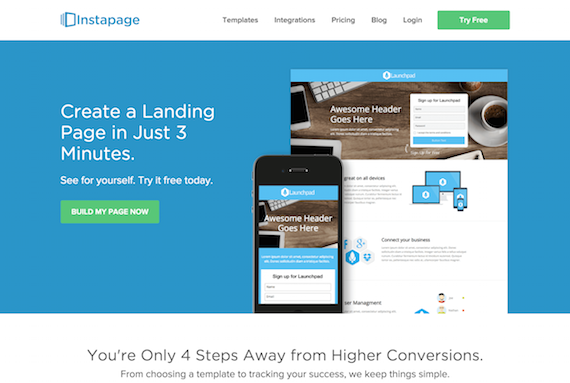
The clarity, directness, and boldness make the message not only immediately understandable, but also immediately impactful.
Another approach is to use the power of mirror neurons to move your audience to action. Mirror neurons were identified by a team of scientists led by Giacomo Rizzolatti in Parma, Italy that was monitoring the brain waves of monkeys. When a graduate student walked into the lab with an ice-cream cone and then raised the cone to his mouth, the monkey’s brain started firing neurons in reaction. What was amazing was that those neurons were the same neurons as if the monkey were eating the ice-cream itself. In other words, the monkey’s brain did not differentiate between the observation of the eating of ice-cream and the actual act of eating it oneself.
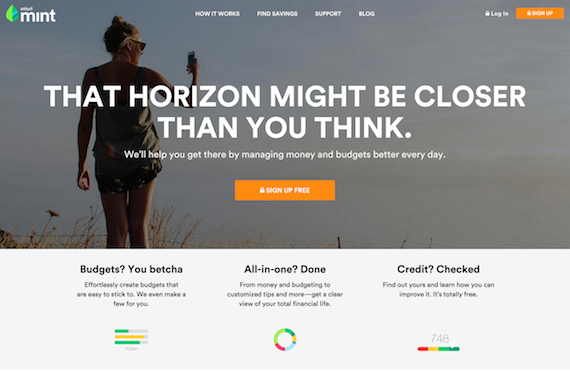
Let’s say that your site visitor is looking for financial management software. Instead of showing only screens of your interface, show your prospective customer what their life could look like if they used your product. The top of the Mint.com home page displays a person by the waterfront under the headline “That Horizon Might Be Closer Than You Think. We’ll help you get there by managing your money and budgets better every day.” The urgent want of the site visitor is not the tactical idea of organizing one’s finances, but instead is peace of mind by achieving sufficient wealth and eliminating money-related anxiety. And through mirror neurons, Mint is triggering their neurons so that site visitors feel as if they are already achieving this.
This is the strategy that many fitness and weight loss programs use in their marketing. All the before-after examples that they feed you are to activate your mirror neurons, because they know that your urgent want is to lose weight and look fit. If they focus instead on specific exercises, or diets, or ingredients in their messaging, the impact is weakened, because the brain does not react as viscerally.
4. Scare the Heck Out of ‘Em
People fear loss more strongly than they seek gain. This aversion to loss is powerful, and can be used effectively when you show prospective customers all the negative effects caused by not purchasing your product.
What’s especially surprising is that even if you present the same information to the prospect but frame it in the sense of what they lose, your conversions can increase. For example, instead of speaking to how your product saves the prospect money, tell them to avoid losing money by making the purchase.
A UCLA study was the first to provide neural evidence that people are hard-wired to avoid loss more than seek gain. The study examined the behavior of people who were given 250+ opportunities to gamble with $30, with a 50-50 chance of winning each time. For example, would they agree to a coin toss in which you could win $30 but could just as easily lose $20? On average, with the risk of losing $10, participants in the study needed the chance to win $19 in order to accept the gamble. The study found that the reward center of the brain responds not only to actual gain and loss, but to potential gain and loss.
Quantifying people’s predilection for loss aversion, Professor Daniel Kahneman at the University of California, Berkeley, who later won the Nobel Memorial Prize in Economic Sciences, found that most people are about twice as sensitive to potential losses as to potential gains.
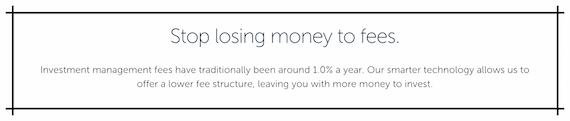
In the examples below, the automated investment software company Betterment uses loss aversion in its messaging to make its site visitors anxious about losing money to excessive fees. They then take that message further by detailing the different types of fees site visitors should worry about losing, such as trade fees, transaction fees, and rebalancing fees.
5. Price It Like You Mean It
You know that the price you set will influence whether a prospective customer buys from you. But beyond just the price, the actual display of the price can also have a major impact at a subconscious level on the buying decision.
Research findings by professors at the University of Richmond and Clark University published in the Journal of Consumer Psychology reveal that the brain believes that a price is actually more affordable or more expensive in just the presentation of the number itself. For example, the price $1,000.00 could be written as $1,000.00, $1,000, $1000.00, $1000 or $1K. The shorter the display of the number, the more affordable it is perceived, even though all of the actual numbers are exactly the same.
A University of Pennsylvania/Carnegie Mellon University study published in the Journal of Consumer Research further revealed that the framing of a price can have a drastic impact on purchase rates. For example, by changing the language for an overnight shipping charge from “A $5 Fee” to “A Small $5 Fee”, purchase rates of tightwads increased by 20%.
Another pricing strategy to drive your prospects to make the purchase is through the use of multiple price points. Even if you have only one product, it’s important to segment the pricing into multiple options (even if one option is going to end up representing 90%+ of the sales).
When I worked at Panasonic, we would always add a more expensive option to any product. Psychologically, when the brain sees two options, it makes it easier for the prospective buyer to make the purchase, as they are either going to feel good about saving money and purchasing the cheaper option, or feel an elevated sense of worth by buying the more expensive option. This is called perceptual contrast.
But keep it simple! Getting carried away by offering more pricing options can easily backfire. In a study by Sheena S. Iyengar at Columbia University and Mark R. Lepper at Stanford University, researchers set up a jam-tasting table at a supermarket. At times they offered six varieties of jam, and at others 24 varieties. While more options brought more tasters, only 3% actually bought the jam. Compare this with a 30% purchase rate when only six varieties were offered. That’s a 10X difference in purchase rate!
Conclusion
The brain is a major influence on whether your target audience will respond to your marketing and will make a purchase from you. By structuring your customer acquisition funnel based on an understanding of neuroscience, you can significantly accelerate your customer growth, increase conversions, and build your business.
About the Author: Tom Shapiro is the CEO of Stratabeat, Inc., a branding, marketing, and design agency. Through his career, Shapiro has developed marketing strategies for a range of startups as well as Fortune 500 companies, including AT&T, Intel, Hewlett-Packard, UnitedHealthcare, and P&G. Follow him on Twitter at @TomShapiro and @Stratabeat.


5 Neuroscience Secrets to a Better Customer Acquisition Engine
Your brain contains approximately 100 billion neurons, which are the cells that enable you to process information. What makes these neurons exponentially more powerful is the electrical or chemical connections they create with one another through synapses – your brain actually houses approximately 2 ½ miles of neuronal network interconnections in every cubic millimeter of gray matter.
Clearly, your brain packs quite the punch. In fact, last year a PhD student from Carnegie Mellon University collaborated with one from University of California, Berkeley to calculate that the human brain is actually up to 30X more powerful than the world’s most powerful supercomputer. Incredible, right?
When considering the dominating influence that the human brain has on the purchase decisions being made by a company’s target audience, it’s stunning how little focus is applied to neuroscience in the customer acquisition development process at many companies.
It behooves any marketer to leverage the power of neuroscience in attracting attention, building relationships, and moving prospects to action. To that end, here are five effective ways to use neuroscience to rev up your customer acquisition engine.
1. Deviate
First, you need to grab the attention of your target audience. On average, your prospective customer encounters over 5,000 marketing messages daily, and this doesn’t even count social media. What’s a marketer to do to cut through all the noise?
Deviate! The brain is hardwired to love surprises, as evidenced in neuroscientific studies lead by Gregory S. Berns, M.D., Ph.D at Emory’s Neuroimaging Group. Using magnetic resonance imaging (MRI) to measure brain activity, Berns’ team showed that the brain actively responds more to the unexpected than even to things a person likes or finds pleasurable.
The dashboard SaaS company, Domo, which targets business executives, ran a series of ads screaming “CFO Porn!” and “Stop making I.T. your report monkey” in an otherwise serious market where they could have otherwise released standard ads about big data.
When seeing the ads, you couldn’t help but click on them. With Domo’s annual revenue reportedly approaching upwards of $100 million, deviation has certainly helped it to stand out.
The monthly razor subscription company Dollar Shave Club has utterly upended a mature industry with its series of jaw-dropping, laugh-out-loud videos, mocking the restrictions in drugstores that treat razor customers like felons or making fun of the excessive technology claims by the established players in the industry. Within 48 hours after launching their first video, approximately 12,000 people signed up for the subscription service. Within a few months, that exploded to 330,000. That first video? It now has more than 22 million views.
Deviating does not necessarily mean shock and awe, though. It just means being demonstrably different from the competition. Take the customer support software company Groove. Its blog first documented its rise from zero to $100K in monthly revenue and now to $500K in monthly revenue. They reveal EVERYTHING, showing you every pimple and scratch along the way. The level of transparency is unprecedented, and you can’t help but get sucked in and become a fan.
So shake it up and be different. Really different! If your brand awareness and direct response activities at the top of the funnel are currently blending in with the massive amount of noise enveloping your audience, craft your marketing for surprise and delight.
Not only does deviation help you to stand out among competing marketing messages, it also helps your target audience to remember you. Today’s consumer or B2B buyer has a higher threshold for stimulation than in the past. If the messages they are consuming are similar, it becomes more difficult for the brain to do the work of figuring out which messages to remember. The more you can deviate from the other inputs, the more likely they are to recall your message when it’s time to buy.
2. Evoke an Emotional Response
If you want new customers, evoke an emotional response. Peter Noel Murray, Ph.D., principal of a consumer psychology practice, reports in Psychology Today that emotional ads outperform content-based ads based on purchase intent by 3-to-1 for TV and 2-to-1 for print intent. Murray also points to fMRI neuro-imagery that shows consumers primarily use emotions over information (brand attributes, features, and facts) to evaluate brands.
According to a study from Google and CEB titled From Promotion to Emotion: Connecting B2B Customers to Brands, B2B brands achieve twice the impact with buyers when using emotional marketing that communicates personal value compared to marketing based on business value. From the study, “Despite our attempts to make purely rational decisions, we are primarily driven by emotional motivations… Purchase intent dips when messaging becomes less emotional.”
In studies by the neuroscientist Antonio Damasio, it was revealed that without emotions, people found it almost impossible to make decisions. Damasio studied a group of people with damage to the part of the brain that triggers emotions yet with their reasoning otherwise unaffected. What Damasio uncovered was that these individuals couldn’t feel strongly enough about one option versus another to make even simple decisions like what to eat, let alone what to purchase.
In other words, if your website is not evoking an emotive response in your site visitors, your marketing is essentially pushing your prospects to NOT make a purchase decision. This is why the marketing of companies like Mailchimp, Autodesk, and Google are centered on emotions. It’s why marketing powerhouses such as Nike, Apple, P&G, Red Bull, and MasterCard focus their marketing on your heart.
The benefits of a strong emotional connection with your audience extend even beyond the purchase itself. Emotion was the number one driver of customer loyalty in 17 of 18 industries studied by Forrester. Not only are emotions critical in ensuring your prospects make the purchase in the first place, but they are also critical in making sure your prospects continue to purchase from you again and again, reducing churn.
3. Identify Their Urgent Wants
People visit your website for one of two reasons. They either want to achieve a goal or eliminate pain. So figure out exactly how your offering does either or both for your site visitors, and then cut the crap and focus all of your messaging on this.
There are different methods to achieve this. One way is a hardcore message that takes your audience by surprise with its penetrating directness. For example, certain marketing teams find it painful to create landing pages in order to drive new leads. Sometimes, they are required to have their web team do the heavy lifting for every page. The SaaS landing page solution Instapage eliminates this pain, with a website containing the super simple and short headline, “Create a Landing Page in Just 3 Minutes” and the call-to-action button “Build My Page Now.”
The clarity, directness, and boldness make the message not only immediately understandable, but also immediately impactful.
Another approach is to use the power of mirror neurons to move your audience to action. Mirror neurons were identified by a team of scientists led by Giacomo Rizzolatti in Parma, Italy that was monitoring the brain waves of monkeys. When a graduate student walked into the lab with an ice-cream cone and then raised the cone to his mouth, the monkey’s brain started firing neurons in reaction. What was amazing was that those neurons were the same neurons as if the monkey were eating the ice-cream itself. In other words, the monkey’s brain did not differentiate between the observation of the eating of ice-cream and the actual act of eating it oneself.
Let’s say that your site visitor is looking for financial management software. Instead of showing only screens of your interface, show your prospective customer what their life could look like if they used your product. The top of the Mint.com home page displays a person by the waterfront under the headline “That Horizon Might Be Closer Than You Think. We’ll help you get there by managing your money and budgets better every day.” The urgent want of the site visitor is not the tactical idea of organizing one’s finances, but instead is peace of mind by achieving sufficient wealth and eliminating money-related anxiety. And through mirror neurons, Mint is triggering their neurons so that site visitors feel as if they are already achieving this.
This is the strategy that many fitness and weight loss programs use in their marketing. All the before-after examples that they feed you are to activate your mirror neurons, because they know that your urgent want is to lose weight and look fit. If they focus instead on specific exercises, or diets, or ingredients in their messaging, the impact is weakened, because the brain does not react as viscerally.
4. Scare the Heck Out of ‘Em
People fear loss more strongly than they seek gain. This aversion to loss is powerful, and can be used effectively when you show prospective customers all the negative effects caused by not purchasing your product.
What’s especially surprising is that even if you present the same information to the prospect but frame it in the sense of what they lose, your conversions can increase. For example, instead of speaking to how your product saves the prospect money, tell them to avoid losing money by making the purchase.
A UCLA study was the first to provide neural evidence that people are hard-wired to avoid loss more than seek gain. The study examined the behavior of people who were given 250+ opportunities to gamble with $30, with a 50-50 chance of winning each time. For example, would they agree to a coin toss in which you could win $30 but could just as easily lose $20? On average, with the risk of losing $10, participants in the study needed the chance to win $19 in order to accept the gamble. The study found that the reward center of the brain responds not only to actual gain and loss, but to potential gain and loss.
Quantifying people’s predilection for loss aversion, Professor Daniel Kahneman at the University of California, Berkeley, who later won the Nobel Memorial Prize in Economic Sciences, found that most people are about twice as sensitive to potential losses as to potential gains.
In the examples below, the automated investment software company Betterment uses loss aversion in its messaging to make its site visitors anxious about losing money to excessive fees. They then take that message further by detailing the different types of fees site visitors should worry about losing, such as trade fees, transaction fees, and rebalancing fees.
5. Price It Like You Mean It
You know that the price you set will influence whether a prospective customer buys from you. But beyond just the price, the actual display of the price can also have a major impact at a subconscious level on the buying decision.
Research findings by professors at the University of Richmond and Clark University published in the Journal of Consumer Psychology reveal that the brain believes that a price is actually more affordable or more expensive in just the presentation of the number itself. For example, the price $1,000.00 could be written as $1,000.00, $1,000, $1000.00, $1000 or $1K. The shorter the display of the number, the more affordable it is perceived, even though all of the actual numbers are exactly the same.
A University of Pennsylvania/Carnegie Mellon University study published in the Journal of Consumer Research further revealed that the framing of a price can have a drastic impact on purchase rates. For example, by changing the language for an overnight shipping charge from “A $5 Fee” to “A Small $5 Fee”, purchase rates of tightwads increased by 20%.
Another pricing strategy to drive your prospects to make the purchase is through the use of multiple price points. Even if you have only one product, it’s important to segment the pricing into multiple options (even if one option is going to end up representing 90%+ of the sales).
When I worked at Panasonic, we would always add a more expensive option to any product. Psychologically, when the brain sees two options, it makes it easier for the prospective buyer to make the purchase, as they are either going to feel good about saving money and purchasing the cheaper option, or feel an elevated sense of worth by buying the more expensive option. This is called perceptual contrast.
But keep it simple! Getting carried away by offering more pricing options can easily backfire. In a study by Sheena S. Iyengar at Columbia University and Mark R. Lepper at Stanford University, researchers set up a jam-tasting table at a supermarket. At times they offered six varieties of jam, and at others 24 varieties. While more options brought more tasters, only 3% actually bought the jam. Compare this with a 30% purchase rate when only six varieties were offered. That’s a 10X difference in purchase rate!
Conclusion
The brain is a major influence on whether your target audience will respond to your marketing and will make a purchase from you. By structuring your customer acquisition funnel based on an understanding of neuroscience, you can significantly accelerate your customer growth, increase conversions, and build your business.
About the Author: Tom Shapiro is the CEO of Stratabeat, Inc., a branding, marketing, and design agency. Through his career, Shapiro has developed marketing strategies for a range of startups as well as Fortune 500 companies, including AT&T, Intel, Hewlett-Packard, UnitedHealthcare, and P&G. Follow him on Twitter at @TomShapiro and @Stratabeat.
Friday, March 25, 2016
3 upcoming trends in paid search
Please visit Marketing Land for the full article.


Tuesday, March 22, 2016
Your first trade for Wednesday, March 23
Brussels TERROR attack: 34 dead, 198 injured as ISIS detonates nail-packed suitcase bomb

A SUITCASE bomb packed with nails was detonated in suicide attacks at Brussels airport and a metro station leaving at least 34 dead and 198 injured.

Monday, March 21, 2016
Texas Capital Bancshares: One Of The Few Banks To Be Bullish On
Wednesday, March 16, 2016
Tuesday, March 15, 2016
How Twitter Donate Buttons Are Redefining the Fundraising Game For Today’s Political Campaigns
More than ever, social media is playing a major role in the way presidential candidates reach voters. Live-tweeting debates, has become the norm, candidates have developed strong social media presences and their Twitter antics are constantly making headlines. But creating conversation is just one of many values social networks bring to the campaign table. 2016 presidential candidates are able to use Twitter as a tool to fundraise for the first time in election history, which has major implications about the best way to target today’s potential donors.
Twitter donate buttons work by allowing candidates to tweet links to approved Square accounts or $Cashtags, which automatically produce “donate now” buttons along with the tweet. Consumers can then click the button, which takes them to a page with payment options. Donors will then have the option to send a tweet about their donation when the process is complete.
Social fundraising has been a key tool for the 2016 presidential candidates, but its usefulness spans a much larger group. Politicians at all levels and nonprofit organizations can use this tool to engage more supporters and raise more money. Twitter’s new political donate feature is unique because it allows political candidates and nonprofit organizations to achieve the following:
Generate donations in real time. With these easy-to-use donate buttons, candidates can raise money quickly and in real time during debates and other large-scale events. Those who are most likely to make a donation are probably also paying attention to breaking news, current issues or live events. So as important news unfolds, it’s easy to send a tweet soliciting donations from your biggest supporters on a platform they’re already engaged with.
Additionally, the tool makes it easy for supporters to make donations quickly. People are known to lose interest if they have to switch sites and click through multiple pages to make the donation. Twitter simplifies this process tremendously, which is crucial in an age where attention spans continue to shrink at an alarming rate.
Target known donors. Twitter is a great way to target high-potential donors because each individual donation is tied to a unique Twitter profile. Using these insights, candidates can better reach individuals who have previously donated and are likely to do so again.
If it’s known that someone has donated in the past, campaigns can target him or her with more personalized Twitter content – whether it’s a mention or direct message. Additionally, the campaign could use what they know about this donor and target them across other channels. Perhaps, based on their profile, the campaign knows that they are a strong supporter of certain social issues. The campaign could then target them with emails containing specific messaging about these issues.
Develop campaign advocates. People are far more likely to share their donation news with friends and family on a social platform than a recent clothing or electronic purchase. In fact, a New York Times study found that 84 percent of consumers share content on social media to show support for a cause or issue they care about.
The Twitter donate feature makes it simple for donors to share their support by automatically generating tweets for them to post once they’ve made a donation. This is a great way to generate grassroots support. When a donor shares a post about her support for a campaign, that message is received by hundreds of her closest family and friends. Consumers inherently trust content from their peers more than anything generated directly by a political candidate.
So as we head into the 2016 presidential primary season, all political campaigns and nonprofit organizations should pay attention to how this year’s candidates are using Twitter to raise money. The new political donation button makes it easier than ever for campaigns to reach the right voters in real time and improve fundraising efforts.
Readers: Have you donated to a political campaign via Twitter?
Gretchen Littlefield is the president of Infogroup Media Solutions


Sunday, March 13, 2016
Chipotle CEOs' insanely high pay was just cut in half
Friday, March 11, 2016
Government officials 'hid stats proving there are a MILLION extra EU migrants in Britain'

SENIOR Government officials have been covering up figures that may reveal 1.3 million extra EU migrants living in Britain, angry MPs have claimed.

Monday, March 7, 2016
Social media analytics service Crimson Hexagon raises $20M
 Crimson Hexagon is announcing that it has raised $20 million in additional equity funding. Founded in 2007, the Boston-headquartered company helps brands and ad agencies track conversations across social media. It says its customer base has grown by more than 65 percent in the last 12 months and now has 10,000 active users. Customers include Starbucks, Walmart and NBC. Crimson Hexagon… Read More
Sunday, March 6, 2016
3 Reasons Union Pacific Stock Could Rise
Saturday, March 5, 2016
Wedding website with organic traffic as Top Source
register : namecheap.com
backlinks: 420
Expires On : Sept 11, 2016
content post: 335
Traffic: around 40 per day
Earning : around $4/month
Friday, March 4, 2016
Forrester Wave: Best Enterprise Social Listening Platforms of Q1 Crowned
Forrester has recently announced the Forrester Wave of Q1, crowning the top enterprise social listening platforms.
Synthesio, Brandwatch, Sprinklr and NetBase earned the title of leaders — the highest designation given by Forrester, taking into account current offering and strategy.
Other honored companies: Networked Insights, Clarabridge, Crimson Hexagon, Salesforce, Cision, Prime Research, Oracle and Sysomos.
In its Forrester Wave report, Forrester discussed what set these companies apart:
As we see this technology mature, listening vendors are keeping pace by adding more features and enhancing functionality. For instance, 10 of the 12 vendors in this Forrester Wave evaluation offer some sort of customer engagement features. as these enhancements mature across the category, we predict that social listening platforms will converge with social relationship platforms. But customers of social listening platforms still struggle to measure the impact of social listening and validate social data’s usage across the organization. To support these endeavors, vendors must tie the social insights that their platforms deliver to the real-world business objectives of their clients.

Brandwatch and Synthesio were also named leaders in the Forrester Wave in the APAC region.

Leah Pope, vp of global marketing at Synthesio, blogged about the honors:
We have been a part of building this industry from the very beginning, so being recognized with top scores in categories such as Current Offering and Corporate Strategy is a great reminder of why we are doing this, and why we are continuing to push harder. As Forrester says “Social listening has moved well beyond just looking for buzz, and now informs marketing content and product innovation, as well as measures brand health.” We believe this is the future of Social Intelligence and we are excited to help solidify the role of social data in smarter businesses.
Sprinklr CMO Tom Butta was pleased with how his company performed, as he noted in a press release:
As the only unified enterprise social engagement platform on the market, Sprinklr empowers brands to leverage an integrated suite of leading technology to connect actionable intelligence with the rest of the enterprise. Our clients have told us for years, and this report confirms for us once again, that the true power of an elite Social Listening tool comes from its ability to bring listening closer to action, informing strategy and improving customer experiences in the moment.


